Collaboration
An Interview with Nani Marquina
Nani Marquina is widely regarded as a pioneer in contemporary Spanish design, bringing modern sensibility to traditional textile craft at a time when few others were doing so. She was among the first to introduce bold, graphic, and globally influenced designs into Spain’s conservative interiors market in the 1980s. Her early work helped open the doors for international recognition of Spain’s design scene, bridging the gap between artisanal tradition and modern design thinking. Her namesake design studio is now internationally renowned for its rug designs, its pioneering stand on sustainability, and collaborations with artists and designers from around the world.
In conversation with Designtex, Catalan designer Nani Marquina reflects on the deeper meanings of repair, how the gesture of sewing gives her hope, and why she can’t stop drawing stripes.
Nani Marquina’s recent collaboration with Designtex, which was five years in the making, reflects her intuitive approach to color, texture, and time. Here, she shares her thoughts on craft, chaos, and why the gesture of sewing still gives her hope.
This collaboration took five years to come to life. Why did it take so long, and what kept you committed to the project?
It wasn’t planned to be so long! But it evolved, and I evolved with it. At first, they asked me to create patterns, even prints. I hadn’t done that in years, but I started there. Eventually, the direction changed. The materials changed. The entire project kept shifting, and I just followed that thread. What kept me going was curiosity. And respect for the process, for the people, and the craft.
You mentioned it felt unusual at first. Why was that?
Because I’m used to smaller-scale projects, more artisanal and selective, and residential, this was for a much larger public, with a different pace and scale. It was a challenge. A good one.
Let’s talk about Mending. What does that word mean to you?
For me, mending is not just a design idea, it’s a gesture. It’s the hand, sewing. That small act of joining things together. It reminds me of childhood, of someone stitching something quietly in the background. It’s humble. But powerful. It speaks to hope.
There’s also a deeper metaphor in there, right?
Yes. The world feels fractured right now. Things are coming apart, politically, environmentally, and socially. So mending becomes this symbolic act of care. You can’t fix everything. But you can hold something together.
Your Join fabric features broken or offset stripes. Tell us about that.
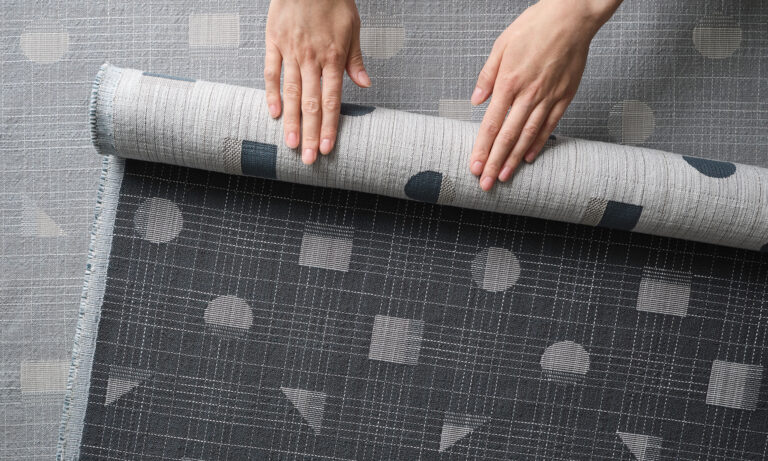
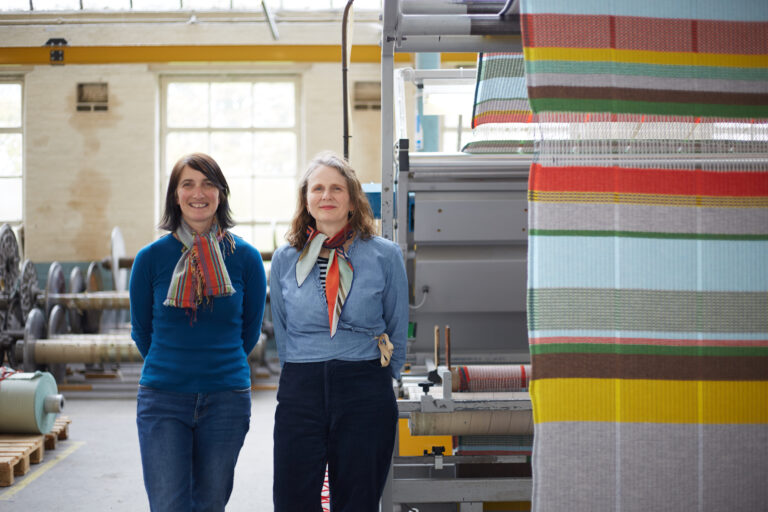
Ah, the stripes! I always draw stripes. I can’t help it. I have a habit, which I call my vice; it’s the thing I constantly do. I am not one of those designers who uses sketchbooks, but when I do, they always have lines after lines, joined together. It’s a way to create order from chaos. And that’s always been my creative tension: I’m very chaotic, but also very organized. I need harmony. Balance. So Join was born out of that: imperfect rhythm, simple repetition, a quiet melody. I think it’s not coincidental that they look a little like piano keys.
How did you approach the color palette in this project?
I used to love bold colors—red, blue, green. Now, I want softness. Calm. I take colors from the land, from stones, clouds, and soil. I split my time between the city and the Costa Brava, and I’ve learned to see light differently. These colors feel more natural, more human.
You also brought a lot of sustainability thinking to this project.
Yes, though I think of it less as a “goal” and more as a way of being. If something lasts longer, that’s good design. If it’s handmade, imperfect, sincere, for me, that’s good design. Sustainability is in the pace, not just the product.
Was there a turning point in the collaboration that felt defining?
Honestly, the technical problems were defining. We had to abandon some fabric structures that just didn’t work. But failure is part of the process. You test, you change, you adapt. Weaving is slow. You can’t force it. That’s part of its beauty.
What do you hope people feel when they touch or sit on these textiles?
A sense of warmth. Of grounding. Of care. These are not cold, minimal surfaces. They are quiet companions. They are made to be lived with.
Was there anything unexpected that moved you about working with Designtex and that shift in scale?
Yes! the reach. I realized that these fabrics wouldn’t just go into beautifully designed homes or curated spaces. They’d end up in public places, offices, hospitals, schools, places where people might be stressed, waiting, thinking, hoping.
In Europe, we often design for a smaller, more design-aware audience. But this project opened that up. It invited me to create something for people I might not usually reach, who don’t necessarily seek out design, but still feel its impact.
Final thought: if this collaboration tells a story—what is it?
It’s a story of unity. Of natural things. Of imperfection. Of taking time and adapting to changes. The word that defines this collection for me is ‘sincero’, not just sincere, but deeply honest. You can feel that in the materials, the process, and the intention.